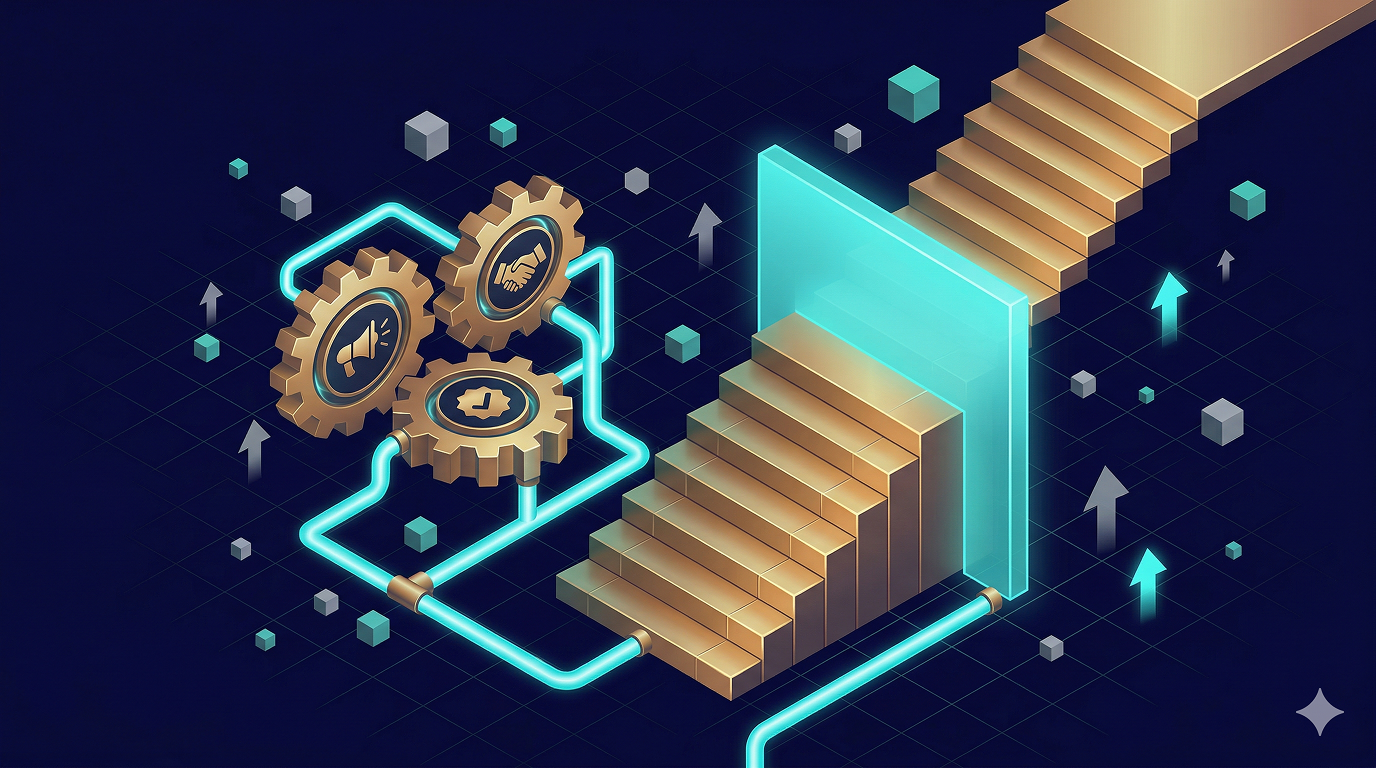
If your business has hit the wall where new sales equal churn, your first instinct is to sell harder. That instinct is wrong. Increasing sales velocity without solving the underlying problem just raises the altitude at which you stall out.
The Wall Where Sales Equals Churn
Every recurring revenue business, whether SaaS or services, eventually hits the same wall. You're adding customers, but you're losing them at roughly the same rate. Growth flatlines. Revenue plateaus. The math is brutal and simple: when monthly churn catches up to monthly acquisition, you stop growing.
I've seen this happen across multiple businesses, on both the SaaS product side and the services side. The plateau isn't a sign that the market has dried up or that your product is broken. It's a structural problem. And the natural response, selling faster, usually makes it worse.
The Obvious Move: Increase Sales Velocity
When you're stuck, the logic is straightforward. If sales equal churn, just sell more. Outrun the problem. Crank up the top of the funnel and push deals through faster.
But decomposing what "sell more" actually requires reveals why it's harder than it sounds. There are three distinct systems in the chain, and a breakdown in any one of them can cap your growth.
Marketing: Do You Actually Have the Leads?
The first question is whether your marketing engine can scale. Do you have enough lead sources? If you doubled your ad spend tomorrow, would leads actually grow proportionally, or have you already saturated your current channels?
Research from Outreach confirms that pipeline volume is one of four critical levers in the sales velocity equation. But volume only matters if the opportunities are real. Pouring money into channels that produce unqualified leads won't move the needle. It'll just make your sales team busier without making them more productive.
If you do have scalable lead sources, great. But that only gets you to the next bottleneck.
Sales: Can You Actually Close?
Let's say marketing is delivering. Leads are flowing in. The next question is whether your sales organization can convert those leads at a consistent rate.
This is where sales velocity gets specific. It's not just about closing deals. It's about the time it takes to move from first contact to signed contract. If your sales cycle is months long, can it be compressed to weeks? Are there automation opportunities? Are your reps spending time on administrative work instead of selling?
The sales velocity formula breaks this into four variables: number of opportunities, average deal size, win rate, and sales cycle length. Improving any one of those levers helps. But when you're stuck at a plateau, you need to figure out which lever is actually stuck, not just push harder on all of them.
A common trap here is assuming the problem is lead volume when the real issue is conversion speed. If it takes 90 days to close a deal and your average customer churns at month eight, you're spending most of your customer's lifetime just getting them in the door.
Customer Success: Can You Deliver at Scale?
This is the one most founders overlook when they're focused on growth. You close the sale. Great. Now can your customer success team actually onboard and retain that customer?
If you doubled sales overnight, could your delivery organization absorb the impact? Do you have the people, the processes, and the systems to onboard twice as many new clients without the quality of service degrading?
On the SaaS side, this means adoption. Are new users actually getting value from the product quickly enough to stick around? On the services side, this means delivery. Are you staffed and structured to fulfill the promises your sales team is making?
Data from MRRSaver shows that SaaS companies in the $1M to $3M ARR range average 3.7% monthly customer churn, while companies above $15M ARR drop to 1.8% net MRR churn. The difference isn't just product maturity. It's that larger companies have built customer success systems that scale. If your customer success function is still ad hoc, scaling sales will just accelerate churn.
The Real Problem With the Sales-Led Fix
Here's the part that most growth advice misses. Let's say you do manage to push through the bottlenecks. You double your marketing spend, tighten your sales process, and scale your customer success team. You go from 10 new sales a month to 15.
You haven't defeated the churn wall. You've just moved it up.
Instead of plateauing at the revenue level that corresponds to 10 sales a month, you'll plateau at the level that corresponds to 15. The structural dynamic hasn't changed. Churn is still a percentage of your growing customer base, and it will eventually catch up to your new, higher acquisition rate.
Research on SaaS growth ceilings confirms this math. Because churn operates as a percentage while acquisition operates in absolute numbers, every business has a theoretical ceiling determined by the ratio between the two. Increasing acquisition raises the ceiling, but it doesn't remove it.
A sales-led approach to breaking through a plateau isn't launching you into the next phase of growth. It's raising the point at which you hit the next plateau and delaying its impact.
What Actually Creates the Next Phase of Growth
If selling harder only moves the wall, what removes it? The answer is reducing churn, improving retention, and building expansion revenue into your customer base.
ProfitWell's data shows that net-new sales in B2B SaaS declined 3.3% as of late 2024, while companies with strong net revenue retention continued to grow. The businesses that break through plateaus aren't the ones that sell the hardest. They're the ones where existing customers generate more revenue over time, not less.
This means investing in the boring stuff: onboarding quality, product stickiness, customer health monitoring, upsell paths, and pricing models that grow with the customer. None of that is as exciting as a new marketing campaign. All of it matters more.
Get an Instant Project Plan + Cost Estimate
Describe your software or AI project. Get a full scope with story-point pricing, sprint estimates, and a downloadable plan in minutes. No calls, no waiting.
Scope Your Project for Free
Free and instant. Try the calculator now.
Frequently Asked Questions
How do I know if I've hit the churn wall or if growth is just naturally slowing?
The churn wall has a specific signature: your net new customers per month flatlines even though your sales activity hasn't dropped. If you're closing the same number of deals but revenue growth has stalled, churn is catching up to acquisition. Natural slowdowns look different. They show up as declining close rates or shrinking pipeline, which are sales problems, not retention problems.
Can't I just reduce churn and increase sales at the same time?
You can, and ideally you should. But the point is that increasing sales alone is not a permanent fix. If you only invest in the sales side, you'll hit the same wall again at a higher revenue number. Reducing churn changes the equation structurally, meaning every new sale contributes more lifetime value and the ceiling moves further away.
What's a realistic monthly churn rate to target?
It depends on your stage and model, but B2B SaaS companies in the growth stage average around 3.7% monthly customer churn. Companies at scale with strong customer success systems get this below 2%. The real target isn't a specific number. It's achieving net revenue retention above 100%, meaning your existing customer base generates more revenue each month through expansion, even after accounting for losses.
How do I diagnose which part of the chain, marketing, sales, or customer success, is the bottleneck?
Work backwards from the plateau. If your pipeline is full but close rates are low, it's a sales problem. If close rates are healthy but you don't have enough qualified leads, it's marketing. If you're closing deals and leads are flowing but customers are leaving within the first few months, it's customer success. Most businesses at a plateau have issues in more than one area, but one is usually the primary constraint.
Does this apply to services businesses or just SaaS?
It applies to any business with recurring revenue or ongoing client relationships. Services businesses hit the same wall when new client acquisition equals client turnover. The mechanics are identical: selling harder raises the plateau but doesn't eliminate it. On the services side, the customer success equivalent is delivery quality and client retention, which are often harder to scale because they depend on people, not software.
Sources
Related: How Much Does It Cost to Build an App · Story Points Explained