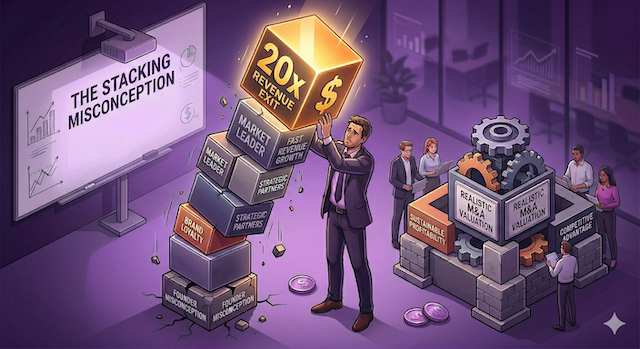
Your Startup's Exit Multiple Isn't Built Up. It's Knocked Down.
Most founders think about M&A valuation wrong. You don't stack favorable conditions to multiply your way to a 20x revenue exit. You start at the ceiling and lose multiples for every box you fail to check.
The Mental Model That Sets Founders Up for Disappointment
Every founder has read about the TechCrunch exit. The headline says "Acquired for $180M." The math on $10M ARR implies 18x revenue. The founder starts mentally engineering their own version of it.
The problem is that 18x exits aren't constructed from average conditions. They require every single factor working simultaneously, in the right direction, at the right moment. Miss one, and the number falls fast. Miss two or three, and you're not anywhere close.
The right mental model isn't addition. It's subtraction. You start with the theoretical ceiling and work your way down.
There are four factors that determine where you land. Growth rate sits at the top. From there, timing, scale, and buyer type each shape the outcome further. Understanding how they interact, and which one kills deals entirely, is the most practical education a founder can get before entering a sale process.
Factor 1: Growth Rate. This One Is Non-Negotiable.
Growth rate is not one factor among equals. It's the gate. Buyers set a floor, and if you're below it, the conversation about multiples doesn't start.
That floor is approximately 20% year-over-year revenue growth. Below that, financial buyers can find better risk-adjusted returns in public equities without the illiquidity, integration cost, or operational complexity of an acquisition. Your startup has to offer something public markets can't. Sub-20% growth doesn't clear that bar.
This isn't an arbitrary number. SaaS Capital's research on public SaaS companies consistently shows that growth rate is the primary driver of ARR multiples. Companies at the high end of the multiple range share one characteristic above all others: they are growing fast. The rest of the business quality factors matter, but they operate inside the constraint that growth sets.
The real target for premium valuations is 50% or higher. That's where acquirers start competing for deals rather than negotiating from a position of indifference. At that growth rate, a buyer can model a future business that justifies paying today's asking price. Below 50%, the math gets harder. Below 20%, it usually doesn't get done at all.
There's a secondary point here worth making explicitly: profitability is not a substitute for growth. A profitable, slow-growing startup is a lifestyle business in the eyes of most acquirers. It generates cash. It doesn't generate excitement. And in a market where buyers have many options, excitement matters.
That said, profitability matters in a different way. A company burning cash at high rates gives the buyer leverage. Every month of runway consumed is negotiating power transferred to the other side of the table. If you can reach profitability, or near it, before you sell, you control the timing of your exit. That control is worth real money.
Factor 2: Timing. Up to 10x Variance Depending on When You Sell.
Given identical businesses with identical fundamentals, the timing of a sale can swing the outcome by a factor of ten. That is not an exaggeration.
At the peak of the 2021 SaaS market, median public SaaS ARR multiples reached nearly 12x. By the trough in 2023, that median had fallen to below 3x. Private company multiples track public markets with a lag and a discount, but the direction and magnitude of the move were similar. A company sold at peak would have received something like four to five times the multiple it would have commanded eighteen months later.
This creates a problem with no clean solution. You can't always time your exit to the market peak. You may not want to sell at the peak. The business may not be ready.
What you can control is the downside. A company that maintains profitability through a downturn doesn't have to sell cheap. The founders of distressed companies are the ones taking whatever they can get at the bottom of the cycle. The ones who survive the trough, intact, get to wait for the next expansion.
The practical implication: treat profitability as optionality. It doesn't just improve your multiple. It lets you decide when to sell.
Factor 3: Scale. From 1x ARR to 10x ARR as Revenue Grows.
Scale affects valuation in a mechanical way. The multiple you can command climbs with the size of the business, and the climb is steep at the low end.
A company doing less than $1M in ARR is unlikely to command more than 1-2x revenue, regardless of growth rate. Buyers at this scale are essentially buying a product and a team. The business isn't yet proven. Below $1M, you're often better off continuing to grow than selling, because the next revenue milestone changes the math significantly.
From $1M to $3M ARR, multiples move into the 3-5x range for companies with good fundamentals. At $5M to $10M ARR, depending on growth and profitability, 5-8x becomes achievable. Above $10M ARR with strong growth, double-digit multiples are in play.
Market data from SaaS Capital and others confirms this pattern consistently: deal size is one of the strongest predictors of the multiple received. This isn't because buyers are irrational. A $10M ARR business offers more certainty, more data, more proven retention, and lower relative execution risk than a $500K ARR business. The premium reflects real risk reduction.
The implication for founders is uncomfortable but clear: if you're pre-$3M, you probably don't want to sell yet, unless something unusual is happening with a strategic buyer. Every dollar of ARR you add changes the denominator in a way that gets more favorable as you scale.
Factor 4: Strategic vs. Financial Buyers. Real Premium, But Not a Multiplier.
Who buys your company matters. A strategic acquirer, a company in a related business that can extract synergies from ownership, typically pays more than a financial buyer, such as a private equity firm buying for return on invested capital.
The premium range that shows up in M&A research is roughly 20-50% above what financial buyers pay, though this varies considerably by deal. An MIT study on 349 US takeover auctions found strategic buyers paid an average premium of 46% over recent trading value, compared to 37% for financial buyers. The mechanism is synergies: a strategic acquirer can model revenue they'll generate from owning your customers, technology, or team that a PE firm can't.
A related, separate point: FOCUS Investment Banking's research shows that prices offered by any buyer type, strategic or financial, can increase 50-100% when a seller moves from a single-buyer proprietary process to a competitive auction. That finding is about process, not buyer category. The practical implication is that how you run the sale matters nearly as much as who shows up to it.
It's also worth noting that strategic buyers don't universally outbid financial ones. A 2024 analysis of software acquisitions found that financial buyers occasionally outbid strategics, particularly when a PE firm is buying an add-on for an existing portfolio company. In that scenario, the financial buyer behaves like a strategic buyer because the synergies are real. Context matters more than category.
What you should take from this: buyer type can improve your outcome meaningfully, but it won't rescue a deal that weak growth or bad timing has already damaged. It's the last factor for a reason.
How the Factors Interact
The reason TechCrunch exits look the way they do is that every factor was maxed out at once. Strong growth, good timing, scale above $10M ARR, and a strategic acquirer willing to pay for synergies. Remove any one of those and the headline number drops.
The reverse is also true. A company with 70% growth but sold at the bottom of the market cycle, at $2M ARR, to a financial buyer, may walk away with a mediocre multiple despite the growth rate. Growth is necessary but not sufficient.
This has a practical consequence for how founders should think about their businesses. The levers you actually have some control over, growth rate, profitability as a buffer against timing risk, and revenue scale, are the ones that matter most. Buyer type emerges from the process you run; you don't get to choose it directly. Timing is partly luck, but maintaining optionality through profitability reduces how much luck you need.
The founders who get the headline exits aren't necessarily smarter. They're often just the ones who got all four factors right at the same time. Understanding the framework at least tells you what to aim for, and more importantly, what not to compromise on.
Get an Instant Project Plan + Cost Estimate
Describe your software or AI project. Get a full scope with story-point pricing, sprint estimates, and a downloadable plan in minutes. No calls, no waiting.
Scope Your Project for Free
Free and instant. Try the calculator now.
Frequently Asked Questions
What is the minimum growth rate needed to attract acquisition interest?
The practical floor is around 20% year-over-year revenue growth. Below that, financial buyers can achieve comparable returns in public markets without the complexity of an acquisition. For premium valuations, the target is 50% or higher. That's the range where multiple acquirers compete for deals rather than negotiate from indifference.
Does profitability hurt your valuation by slowing growth?
Not necessarily, and the framing is often wrong. Profitability doesn't cap your growth rate unless you're choosing not to reinvest. What profitability does is give you control over timing. A profitable company doesn't have to sell at the bottom of a market cycle. That optionality has real financial value, especially given that timing can swing your multiple by as much as 10x.
How much does scale actually change the multiple you can command?
Substantially, especially at the low end. A sub-$1M ARR company rarely commands more than 1-2x revenue regardless of growth. A $10M ARR company with strong fundamentals can achieve double-digit multiples. The jump from $1M to $10M in ARR doesn't just add more revenue to multiply. it moves you into an entirely different buyer category with different risk profiles and different willingness to pay.
Is a strategic buyer always worth more than a financial buyer?
Usually, but not always. Strategic buyers can pay a meaningful premium when they perceive specific synergies with your product, customers, or technology. Academic research suggests average premiums of 20-50% over financial buyers in competitive processes. However, a well-capitalized private equity firm acquiring an add-on for a portfolio company can behave similarly to a strategic buyer. The more reliable advice: run a competitive process that includes both buyer types and let the market tell you who values the business most.
Why do most acquisitions fail to hit the multiples founders expect?
Usually because founders optimize for one factor in isolation. They hit strong growth but try to exit before reaching meaningful scale. Or they wait for scale but miss the timing window. The headline exits require all four factors aligned simultaneously, which is rare. Understanding the full framework earlier gives founders time to position each variable deliberately rather than hoping they align by accident.
Can you recover a weak multiple by finding the right buyer?
Buyer type can improve your outcome by a meaningful percentage, but it won't overcome weak fundamentals. A strategic buyer pays a premium over what the financial market would pay for your business. If low growth has already compressed the financial market's view of your value, the strategic premium is applied to a lower base. Buyer type is the last factor for a reason: it has the least leverage on its own.
Sources
SaaS Capital. "SaaS Valuation Multiples: Understanding the New Normal." https://www.saas-capital.com/blog-posts/saas-valuation-multiples-understanding-the-new-normal/
Aventis Advisors. "SaaS Valuation Multiples: 2015–2026." https://aventis-advisors.com/saas-valuation-multiples/
Jackim Woods & Co. "How to Value Your Private SaaS Business in 2025." https://www.jackimwoods.com/how-to-value-your-private-saas-business-in-2025/
FOCUS Bankers. "Strategic or Financial: Which Buyer Pays More?" https://focusbankers.com/strategic-or-financial-which-buyer-pays-more/
L40°. "Financial vs. Strategic Buyers: Choosing Right for Your SaaS." https://www.l40.com/insights/financial-vs-strategic-buyers
Related: How Much Does It Cost to Build an App · Story Points Explained