Oops! Something went wrong while submitting the form.
By providing a telephone number and submitting this form you are consenting to be contacted by SMS text message. Message & data rates may apply. You can reply STOP to opt-out of further messaging.
Code Generation with AI: How Engineering Teams Double Their Productivity
AI code generation isn't just autocomplete — it's the variable that separates teams shipping twice as fast from teams running the same playbook they used three years ago.
Praveen Ghanta, CEO, Hire Fraction·July 17, 2024·11 min read
AI code generationengineering productivitygenerative AIdeveloper tools
What you’ll learn
The specific productivity multiplier Fraction observed across engineering teams using generative AI — and the exact condition required to reach 4x output
How five distinct AI model architectures (transformers, Seq2Seq, RNNs, GANs, AutoML) handle code generation differently, and which one dominates everyday engineering use
Why AI tools reduce bugs on routine tasks but introduce a new class of quality risk that standard code review wasn’t designed to catch
The five evaluation criteria for selecting a code generation tool that actually fits your team’s stack and workflow
What security risk mitigation looks like in practice — including the audit and testing protocols that production teams use for AI-generated code
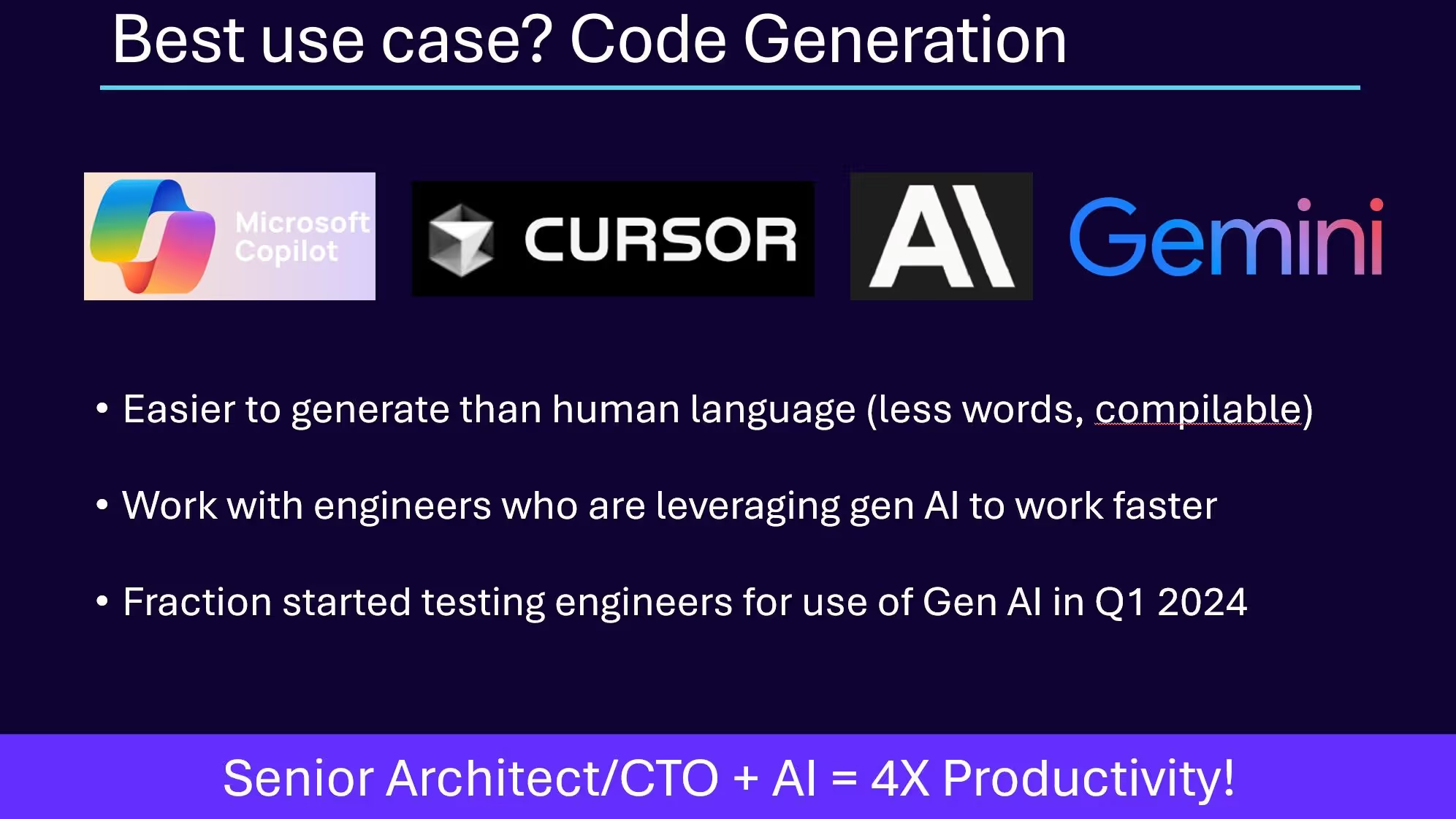
Since 2016, generative AI has been quietly transforming how engineers write software. The question is no longer whether AI code generation tools work — Fraction’s own engineering teams show a consistent twofold productivity increase for engineers using them well, and up to four times that when paired with strong technical leadership. The question is how to implement them without the pitfalls that undercut the gains.
What is AI code generation and why does it matter for engineering teams?
AI code generation is the use of machine learning models — trained on large datasets of existing code and documentation — to produce functional code from natural language prompts, partial implementations, or contextual cues from a developer’s existing work.
Definition
Generative AI code generation: the process by which large language models and specialized code models analyze existing codebases, programming patterns, and natural language descriptions to produce syntactically correct, contextually appropriate code. Unlike rule-based autocomplete, generative models understand intent and can produce entire functions, classes, or modules from a high-level description.
Today’s AI code generation tools — including Codeium, GitHub Copilot, Polycoder, and OpenAI’s models — do more than fill in boilerplate. They understand contextual requirements, adapt to different programming languages and styles, and generate first-draft implementations from plain-language descriptions of what the code should do.
The business case is straightforward: engineering time is the primary constraint on software delivery. Any tool that compresses the implementation layer — even partially — changes project economics significantly. For teams with senior engineers who know how to direct AI output and catch its mistakes, the multiplier effect is substantial.
How do AI algorithms actually generate code?
AI code generation works through a pattern-recognition process operating at massive scale. Models are trained on hundreds of millions of lines of code drawn from open-source repositories, technical documentation, and developer forums. During training, the model learns statistical relationships between code structures, language semantics, and common implementation patterns.
At inference time — when a developer types a prompt or a partial function — the model predicts the most likely continuation based on what it learned during training. Advanced models go further: they understand contextual requirements, recognize the programming language in use, adapt to the style conventions in the existing file, and produce output that fits within the wider codebase.
This isn’t static pattern matching. The technology continuously improves through feedback loops and real-world applications. Models fine-tuned on internal codebases perform better on domain-specific tasks than general-purpose models — a distinction that matters for teams building specialized systems.
The practical result: AI systems can produce clean, well-structured code within seconds for routine tasks. The speed advantage is most pronounced on the kinds of repetitive work that slow down senior engineers most: writing tests, generating boilerplate, scaffolding API integrations, and converting specifications into initial implementations. For teams exploring how to boost human productivity with AI across the organization, the engineering function is almost always where the highest-ROI use cases concentrate first.
Which AI model types are used for code generation, and which should you choose?
Code generation draws on several distinct model architectures, each with different strengths. Understanding which one underlies a given tool helps you predict where it will excel and where it will fall short.
Model Type
How it works
Best for
Example tools
Transformer (LLM)
Captures long-range context across entire files and prompts
General-purpose generation, multi-language tasks
GPT-4, GitHub Copilot, Codeium
Seq2Seq
Maps input sequences to output sequences end-to-end
Code translation between languages
CodeT5, CodeT5+
Recurrent Neural Network (RNN)
Processes sequential data token by token with memory
Line-by-line completion, sequential pattern tasks
Older completion engines
GAN (Generative Adversarial Network)
Pits generator and discriminator networks against each other
Diverse snippet generation, adversarial testing
Research applications
AutoML
Automates model architecture selection and optimization
ML pipeline generation, model selection tasks
Specialized ML platforms
For most engineering teams, the practical choice is among transformer-based tools. Models like GPT-4 dominate general-purpose code generation because they understand context across long prompts — an entire file, multiple function signatures, or a detailed specification. Tools like Codeium and Polycoder are purpose-built for coding contexts and integrate directly into VS Code and JetBrains IDEs.
Seq2Seq models like CodeT5 and CodeT5+ have specific advantages for code translation — converting Python to TypeScript, migrating from one framework to another — because of how they’re trained to map one sequence structure to another. If your team spends meaningful engineering time on migration work, these specialized models may outperform general-purpose transformers for that task.
What are the real productivity gains from AI code generation?
The productivity numbers from Fraction’s engineering work are specific: engineers using generative AI tools effectively see output approximately double. When that AI-assisted capacity is paired with architect-level oversight — a CTO or senior technical lead who directs the work and catches architectural mistakes — the productivity effect reaches approximately four times the baseline.
The mechanism behind both figures is the same: AI tools handle more of the implementation layer, freeing engineers to spend time on the work where human judgment is irreplaceable — system design, code review, debugging complex interactions, and making architectural decisions that affect the product years from now.
The gains break down roughly as follows across task types:
Repetitive implementation work (boilerplate, standard CRUD operations, test scaffolding): AI handles 70–90% of the first draft, with human review before merge
API integration: AI generates initial integration code from documentation; engineers validate against actual API behavior and edge cases
Documentation and code comments: AI drafts; engineers correct inaccuracies that come from the model not having runtime context
Complex algorithmic work and system architecture: AI is a useful sounding board but rarely produces production-ready output without significant human direction
One underappreciated benefit is error reduction on routine tasks. AI tools that generate boilerplate from a consistent template produce fewer typos, fewer missed edge cases in standard patterns, and fewer copy-paste errors than engineers working through the same tasks manually. The gains are smallest in exactly the areas where engineers prefer to work: novel problems requiring deep domain knowledge. That asymmetry is worth internalizing when setting expectations with teams.
For teams building AI features into their products — not just using AI for internal tooling — the productivity multiplier extends further. Working with production-grade AI engineers who specialize in LLM and RAG systems allows teams to avoid the common pattern of building internal AI expertise before the product architecture is proven.
Ready to scope an AI-assisted engineering project?
Get a structured cost estimate with story-point ranges by component — architecture, integrations, testing infrastructure, and deployment — in minutes.
How do you implement AI code generation tools effectively in an engineering team?
Implementation fails most often in two ways: teams adopt tools without a clear plan for directing and reviewing AI output, or they skip training entirely and assume engineers will figure it out. Neither produces consistent gains.
Choosing the right tools
Evaluate code generation tools against five criteria before committing:
Compatibility — Does the tool integrate cleanly with your existing stack and IDE? A tool that requires workflow changes to use will see low adoption regardless of capability.
Usability — Is the interface intuitive enough that engineers will reach for it habitually, rather than treating it as an occasional experiment?
Functionality breadth — Does it cover the languages, frameworks, and task types your team actually encounters, or does it excel only in specific contexts?
Community and support — Active documentation and user communities matter when the tool behaves unexpectedly or needs configuration for unusual use cases.
Scalability — As your codebase and team grow, will the tool’s performance hold? Some tools degrade in quality when context windows fill with long files or large codebases.
Training your team for consistent results
The single largest variable in AI productivity gains is prompt quality — how specifically engineers describe what they need. Vague prompts produce generic output that requires significant rework. Specific prompts that include language, constraints, expected behavior, and edge cases produce output that’s usable in far fewer revision cycles.
Effective training programs run engineers through real tasks from the current backlog, not toy examples. The goal is developing judgment about when to trust AI output and when to rewrite it — calibration that comes from experience, not from watching demos.
Establish team norms around AI output in code review. AI-generated code should go through the same review process as human-written code. Teams that skip review for AI output because “the AI wrote it” are creating technical debt faster than they’re shipping features. For teams considering building agentic AI systems, the discipline of reviewing AI output carefully at the code level translates directly to the more complex task of evaluating agent output at the system level.
What security and code quality risks come with AI code generation?
AI code generation introduces a class of quality risk that standard code review practices weren’t designed to catch: plausible-looking code that is subtly wrong in ways that don’t surface until load, edge cases, or security testing.
The primary security concerns fall into three categories:
Vulnerability introduction — AI models trained on public code have learned from code that includes insecure patterns. Improper input validation, insecure dependency choices, and hardcoded secrets appear in AI output at non-trivial rates. Engineers who accept generated code without scrutiny inherit these issues.
Training data exposure — If your prompts include proprietary code, credentials, or internal system details, you may be sending that information to external model providers. Establish clear policies on what can and cannot be included in AI prompts before teams start using hosted tools.
Over-reliance on output — Engineers who trust AI output without understanding it lose the ability to catch errors that require knowing what the code is actually doing, not just what it looks like it’s doing.
Mitigating these risks requires adding specific checkpoints to existing processes: routine security audits of AI-generated code sections, static analysis tools that flag common vulnerability patterns in output, and code review norms that explicitly require reviewers to understand AI-generated code rather than defer to it.
For ensuring high code quality alongside AI tools, add the following to standard quality processes:
Unit testing of AI-generated code — AI is good at generating tests for code it wrote, but those tests often test what the code does rather than what it should do. Human review of test coverage and test quality is necessary.
Integration testing emphasis — AI-generated code that passes unit tests can still interact poorly with other system components. Integration test coverage becomes more important, not less, when AI generates more of the implementation.
Continuous improvement loops — Track where AI output requires the most rework and use that data to refine prompting practices and identify which tool performs best for which task types.
Where is AI code generation heading and what should engineering teams prepare for?
The trajectory of AI code generation points toward higher capability at higher abstraction levels. Current tools primarily assist with implementation — writing code from specifications. The near-term development frontier is tools that participate in architectural decisions, flag design tradeoffs, and generate entire service stubs from API contracts rather than just function bodies.
Large language models integrated with code execution environments are an active area: tools where the model can run the code it generates, observe the output, and revise based on actual runtime behavior rather than predicted behavior. This closes a significant gap in current tools — the model currently cannot know whether the code it produces actually runs correctly, only whether it looks syntactically plausible.
The skills evolution for engineering teams follows from this trajectory. Engineers who develop strong judgment about what AI output to trust, how to direct models toward production-quality results, and how to review AI-generated code efficiently will become more valuable as AI handles more of the routine implementation work. The value of understanding system design, performance characteristics, and failure modes increases as AI absorbs more of the surface area of basic coding.
Teams that integrate AI code generation tools now — and build the training, review practices, and quality controls around them — will have a meaningful advantage as the tools continue to improve. The learning curve for effective AI-assisted development is not trivial, and teams that delay adoption delay building that institutional knowledge.
Frequently asked questions
How much does AI actually improve developer productivity? The productivity gains from AI code generation vary by team and use case, but Fraction’s own engineering work shows a consistent twofold increase for engineers who use generative AI tools effectively. When AI-assisted engineers work alongside architect-level talent — CTOs or senior technical leads who can shape the work — productivity can reach four times the baseline. The gains are most pronounced on repetitive coding tasks: boilerplate generation, test writing, documentation, and translating specifications into initial implementations. Which AI model types are best for code generation? Transformer models like GPT-4 are the dominant choice for general-purpose code generation because they excel at understanding context across long prompts. Seq2Seq models are well-suited for code translation tasks — converting from one language to another. Recurrent Neural Networks handle sequential patterns well, making them useful for line-by-line code completion. For teams starting out, a transformer-based tool like GitHub Copilot or Codeium covers the majority of everyday use cases without requiring specialized model selection. What are the security risks of using AI for code generation? The primary risks are: AI-generated code that introduces vulnerabilities the developer doesn’t notice (insecure dependencies, improper input validation, hardcoded credentials), training data leakage if your prompts contain proprietary code, and over-reliance on generated code without understanding it. Mitigating these risks requires routine security audits of AI-generated code, clear policies on what data can be included in prompts, and maintaining code review processes that don’t treat AI output as pre-approved. How do you train an engineering team to use AI code generation tools effectively? The most effective training approach combines structured onboarding with hands-on practice in real projects. Cover the basics of how the tools work, what they’re reliably good at, and where they commonly fail. Run workshops where engineers solve real problems with AI assistance rather than toy examples. Establish team norms around prompt quality — the specificity of the instruction has the largest single effect on output quality. Finally, include code review checkpoints specifically for AI-generated code until the team has developed good judgment about when to trust outputs. Does AI code generation reduce the need for senior engineers? No — it changes what senior engineers spend time on, rather than replacing them. AI tools handle more of the implementation layer, which frees senior engineers to focus on architecture, system design, code review, and directing where AI-generated work goes. Fraction’s data shows productivity gains are highest when AI tools are paired with strong technical leadership, not when they’re used as a substitute for it. The teams that realize the smallest gains are those that use AI as a crutch to avoid thinking through system design.
Praveen Ghanta
CEO, Hire Fraction
Praveen Ghanta is a five-time founder and serial entrepreneur. He is the founder of DevHawk.ai, an AI-powered engineering management platform, and Fraction.work, which connects fast-growing companies with top fractional tech and growth marketing talent. Previously, he founded HiddenLevers, a risk analytics platform for wealth management that he bootstrapped from inception to acquisition by Orion Advisor Solutions in 2021, serving thousands of advisors and $600B in assets. He earlier founded SmartWorkGroups, acquired by Intralinks in 2000.
Describe your software or AI project. Get a full scope with story-point pricing, sprint estimates, and a downloadable plan in minutes. No calls, no waiting.