Oops! Something went wrong while submitting the form.
By providing a telephone number and submitting this form you are consenting to be contacted by SMS text message. Message & data rates may apply. You can reply STOP to opt-out of further messaging.
Why three vendors can quote the same brief at $40K, $95K, and $180K — and all be technically correct given their own assumptions
The five variables that move custom software cost most, ranked by the leverage each gives you before you sign anything
Why unclear requirements cost more than any other single factor — and how change orders arrive after commitment, not before
The structural difference between time-and-materials and outcome-based pricing, and which one puts financial pressure on the vendor instead of you
How to use an independent estimate to evaluate a vendor quote rather than guess between numbers you cannot interrogate
At some point in this process, you will receive a quote. It will arrive in a PDF, or a slide deck, or a follow-up email after a call that felt promising. It will look considered. And you will have almost no way to know whether it is right. That is not an accident. It is how software procurement is structured, and it systematically disadvantages the person who has not done this before.
Why do quotes for the same project vary so much?
You write a brief, find three agencies with good reviews, and send it out.
The proposals arrive. One comes in at $40,000. Another at $180,000. A third at $95,000. All three reference the same brief. None of them explain why the numbers are so different.
At this point, most buyers do one of two things. They pick the middle number because it feels safe. Or they pick the lowest because the budget is tight and the vendor seemed trustworthy on the call.
What they do not yet know is that each vendor scoped the project differently. One included a custom admin dashboard. One assumed you would use an off-the-shelf tool. One priced in three rounds of revisions. One priced in none. Those decisions are buried in assumptions nobody showed you, invisible in the final number.
The cheapest quote is usually cheapest because it contains the most unstated assumptions — not because the vendor is more efficient. You find out which assumptions were wrong when the change orders arrive, typically after kick-off, when walking away is no longer a real option.
Six months later, the $40,000 project cost $110,000 and still is not live. The cause is rarely technical. It is almost always scope that was assumed rather than defined, and a budget that reflected optimism more than analysis.
Definition
Change order: a formal amendment to a software development contract that adjusts scope, timeline, or cost after the project has started. Change orders typically arise when a vendor’s original assumptions turn out to be incorrect — a feature proved more complex than estimated, a third-party integration behaved unexpectedly, or a requirement that was vague at the time of quoting is now being defined precisely for the first time. In a time-and-materials contract, change orders are the primary mechanism by which initial budget estimates are exceeded.
Why does the information gap between buyers and vendors persist?
The standard defence is that software is complex and every project is different. Both are true. Neither explains why buyers are routinely left with numbers they cannot interrogate.
The structural problem is this: pricing depends on scope, scope depends on requirements, and requirements are almost never fully defined when an estimate is produced. A vendor quoting you in week one is quoting against assumptions they have not shown you. When those assumptions turn out to be wrong, the contract does not protect you. It becomes the starting point for a conversation about what has changed.
We repeatedly see buyers discover this at the worst possible moment: after kick-off, after the first invoice, after the relationship has enough momentum that stopping feels more expensive than continuing. By then, the information asymmetry that existed before the contract was signed has become a budget problem that is entirely the buyer’s to absorb.
The vendor is not always acting in bad faith. They are often quoting from a one-hour call and a rough brief, filling gaps with optimism because that is what closes deals. You are reading the number as a commitment because that is what it looks like. Nobody corrects the mismatch until the money is already moving.
The incentive structure makes this worse. In a time-and-materials model, where you pay for developer hours regardless of what gets built, a project that runs long is not a failure for the vendor. It is more revenue. There is no financial pressure on their side to finish faster or scope more accurately. That pressure sits entirely on you.
What does custom software actually cost, and why?
Two projects can look identical in a brief and cost completely different amounts to build. That gap is not random. It follows from a small number of variables that vendors understand and most buyers do not.
The first is complexity, and it is almost always underestimated. Buyers think in outcomes. A healthcare operator describes a “patient intake form.” A developer hears role-based access, audit logging, HIPAA-compliant data storage, and a document management layer. Both descriptions are accurate. They describe the same thing from opposite ends of the build. The gap between those two perspectives is where scope quietly expands before anyone calls it a change order.
Integrations compound this. The moment your software needs to communicate with something else — a payment processor, an EHR system, an accounting tool, a logistics API — you have introduced a dependency on a third-party system you do not control. Each one adds coordination, testing, and debugging overhead that is genuinely hard to predict in advance. A project with three integrations is not three times harder than a project with one. It is often considerably more, because the failure modes multiply.
Project type
Typical scope
Indicative range
Simple internal tool
2–3 features, no integrations, single user role
$15K–$50K
Consumer-facing product
Auth, core feature set, 1–2 integrations
$50K–$150K
Operational platform
Multiple roles, several integrations, admin dashboard, reporting
$150K–$400K
Regulated-industry product
Compliance layer, audit trails, data sensitivity requirements
$300K+
The single largest lever on total cost is often simpler: where your team is based. A US-based agency can cost three to four times more per hour than a comparable Eastern European team, and more still compared to South Asian teams. Rate is not a reliable signal of quality. But if you are comparing proposals without knowing where each team is located, you are not comparing the same thing.
What surprises most first-time buyers is that unclear requirements often cost more than any of the above. Not because ambiguity is expensive in principle, but because vendors quote optimistically into it. When a requirement that was assumed turns out to be more complex than the vendor priced, that is not a mistake. It is a change order. And change orders arrive after kick-off, after commitment, when the cost of stopping exceeds the cost of paying.
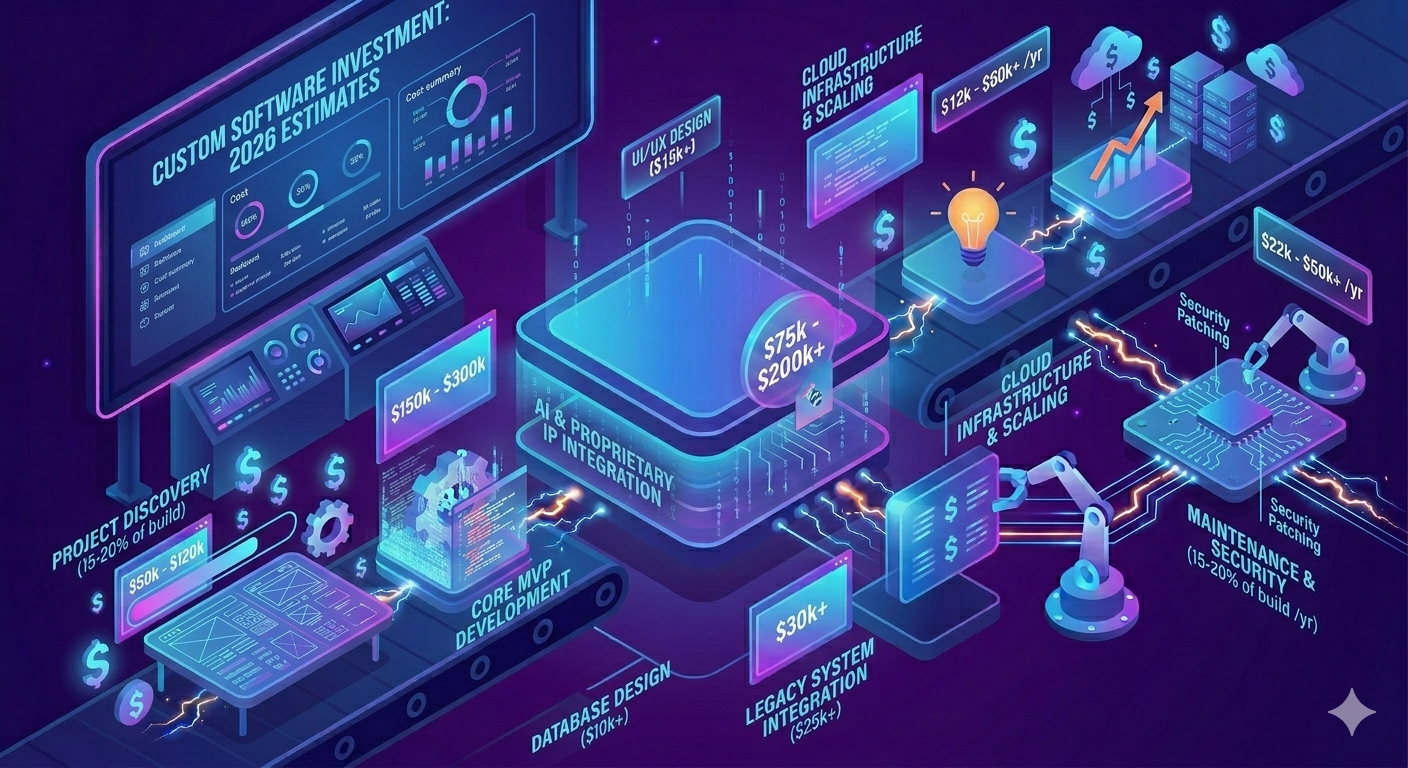
None of this accounts for what comes after launch. Maintenance, hosting, security updates, and future feature development are ongoing costs that rarely appear in an agency proposal. The build is the beginning of the spend, not the end of it. If you are also evaluating the cost of building an MVP first, the same scoping principles apply — the variables that drive cost are identical regardless of how you frame the initial scope.
How should you write your product brief before getting quotes?
Most first-time buyers treat the product brief as a formality. Something to send so the vendor has enough to go on. A few paragraphs about the idea, a rough feature list, a note about the industry. Then wait for the proposals.
The brief is actually the most important document in the entire project. Not the contract. Not the statement of work. The brief. Because every requirement you leave undefined is an assumption the vendor fills in on your behalf — and when their assumption differs from what you meant, that gap has a price.
The brief is also the only moment in procurement where you have full control and no cost. Once you have signed, ambiguity belongs to the vendor.
What the brief really forces you to answer is not “have I given them enough to quote against?” It is “do I actually know what I am building?” Vendors rarely help you answer that second question. Their incentive is to start, not to scope.
If you cannot define what “done” looks like for a core feature, you are not ready to receive a quote. Not because an estimator will not produce a number — it will — but because any quote built against a vague brief is a number the vendor invented. Filled with assumptions you have not seen, against requirements that do not fully exist. You have no way to evaluate it, because there is nothing solid to evaluate against.
Don’t know what your project actually costs?
Feed your brief into Fraction’s estimator and get a structured cost breakdown by feature area — before you talk to a single vendor.
What protects you once you are inside a vendor relationship?
Understanding cost ranges gets you to the table. It does not protect you once you are sitting at it.
The standard agency model is time-and-materials: you pay for developer hours regardless of what gets built. If the project runs long because a requirement was underestimated, or a third-party integration behaved unexpectedly, or scope shifted mid-build, you absorb the cost. The vendor’s margin is protected either way. There is no financial consequence for them when the project runs over. That consequence is entirely yours.
Outcome-based pricing works differently, and the difference matters before you sign anything. When cost is tied to defined, deliverable pieces of functionality rather than hours logged, the vendor’s margin depends on building efficiently. That financial pressure changes the dynamic. It also forces transparent scoping earlier, because you cannot price a deliverable that has not been defined. That front-loaded clarity is where a significant amount of budget protection comes from — not the contract language, not the project manager, but the definition of done that exists before kick-off.
This is worth asking about directly when you evaluate vendors. How do you price? What happens when a feature takes longer than estimated? What does a change order look like, and when does one get triggered? A vendor who can answer those questions clearly — before you have committed to anything — is a different proposition from one who cannot.
How can an independent estimate change the negotiation?
The Fraction estimator exists for the gap between “I have an idea” and “I am sitting across from a vendor who has already decided what it costs.”
Feed it your product brief and it returns a structured breakdown by feature area, with cost bands and assumption flags. It does not replace a vendor quote. It gives you an independent reference point before you negotiate one, so you are no longer evaluating a number in a vacuum. You are comparing it against a structure you built before anyone was trying to sell you anything.
Where it earns its keep is before you talk to anyone. A well-defined feature returns a useful cost band. A vague one returns a range so wide it is meaningless. That is not a flaw — it is the signal. It tells you exactly where a vendor will quote optimistically into your ambiguity, and where you will pay to find out later. Clearing that up before you enter any vendor conversation is the cheapest work you will do on this project.
The buyers who end up $100,000 over budget are not always the ones who received a bad quote. They are often the ones who had no way to recognise it. An independent estimate built on the same brief — before any vendor conversation — closes that gap. Understanding what AI development costs in 2026 follows the same logic: the same scoping discipline that protects you on a standard software build protects you when the project involves an AI layer too.
You do not need to become technical to buy software well. You need cost certainty before you commit, and a signal that was not produced by the person selling to you. That combination — a clear brief and an independent reference point — is what separates buyers who stay on budget from those who do not.
Frequently asked questions
How do I know if the quote I received is reasonable? A reasonable quote breaks down cost by feature or functional area, states the assumptions behind each estimate, and defines what “done” means for each deliverable. If your quote is a single number with a timeline and not much else, you have no way to evaluate it because there is nothing to evaluate against. The most useful thing you can do is build an independent reference point before you respond to any vendor. When you compare a structured estimate from a neutral source against what a vendor is proposing, gaps become visible: features priced significantly higher than expected, assumptions that were never discussed, scope that was quietly added or removed. Why did I get three completely different quotes for the same project? Because each vendor scoped the project differently. A brief that describes outcomes leaves significant room for interpretation at the component level. One vendor included a custom admin panel. Another assumed you would use an off-the-shelf solution. One priced three rounds of revisions. One priced none. Those decisions are rarely visible in the final number, which means you are comparing figures that do not reflect the same scope. Before you can meaningfully evaluate quotes, you need a shared definition of what is actually being built. Without that, choosing between three different numbers is closer to a guess than a decision. How accurate is an AI-generated software estimate? Accurate enough to be useful, not accurate enough to be a contract. An AI-assisted estimator works by breaking your brief into feature areas and returning cost bands based on comparable builds. The accuracy depends heavily on the quality of the input: a well-defined brief produces a useful range, a vague brief produces ranges wide enough to be meaningless — which is itself useful information because it shows you where your thinking needs more work before you talk to a vendor. What AI estimation does well is consistency. It applies the same logic across every feature without the optimism bias that often shapes a vendor’s opening quote. Use it as a calibration tool, not a substitute for a properly scoped engagement. What is the biggest hidden cost in custom software projects? Unclear requirements. Not because ambiguity is expensive in principle, but because vendors quote optimistically into it. When a requirement that was assumed turns out to be more complex than the vendor priced, that is not a mistake — it is a change order. Change orders arrive after kick-off, after commitment, when the cost of stopping exceeds the cost of paying. The buyers who end up 50–100% over budget are not always the ones who received a bad quote; they are often the ones who had no way to recognise it. What is outcome-based pricing in software development? Outcome-based pricing ties cost to defined, deliverable pieces of functionality rather than hours logged. Because the vendor’s margin depends on building efficiently, there is financial pressure on them to scope accurately and finish on time — pressure that does not exist in a time-and-materials model. It also forces transparent scoping earlier, because you cannot price a deliverable that has not been defined. That front-loaded clarity is where a significant amount of budget protection comes from. How much does team location affect software development cost? Significantly. A US-based agency can cost three to four times more per hour than a comparable Eastern European team, and more still compared to South Asian teams. That differential can change total project cost by 40 to 60 percent. Rate alone is not a reliable signal of quality — but if you are comparing proposals without knowing where each team is located, you are not comparing the same thing. Treat location as a separate, explicit variable rather than letting it hide inside an opaque total.
Praveen Ghanta
CEO, Hire Fraction
Praveen Ghanta is a five-time founder and serial entrepreneur. He is the founder of DevHawk.ai, an AI-powered engineering management platform, and Fraction.work, which connects fast-growing companies with top fractional tech and growth marketing talent. Previously, he founded HiddenLevers, a risk analytics platform for wealth management that he bootstrapped from inception to acquisition by Orion Advisor Solutions in 2021, serving thousands of advisors and $600B in assets. He earlier founded SmartWorkGroups, acquired by Intralinks in 2000.
Describe your software or AI project. Get a full scope with story-point pricing, sprint estimates, and a downloadable plan in minutes. No calls, no waiting.