Oops! Something went wrong while submitting the form.
By providing a telephone number and submitting this form you are consenting to be contacted by SMS text message. Message & data rates may apply. You can reply STOP to opt-out of further messaging.
AI Strategy
Why Most AI Projects Fail
Most AI projects don't fail because the technology doesn't work. They fail because the project was never set up to succeed.
Praveen Ghanta, CEO, Hire Fraction·March 10, 2026·5 min read
AI projectsAI failureAI strategyAI consultingenterprise AI
What you’ll learn
Why the majority of AI initiatives fail to produce meaningful business value
The five root causes of AI project failure — and how each one shows up in practice
What distinguishes the 26% of organizations that consistently get value from AI
How to structure scoping so common failure modes are caught before the build starts
What a post-deployment maintenance plan should include to keep AI systems reliable
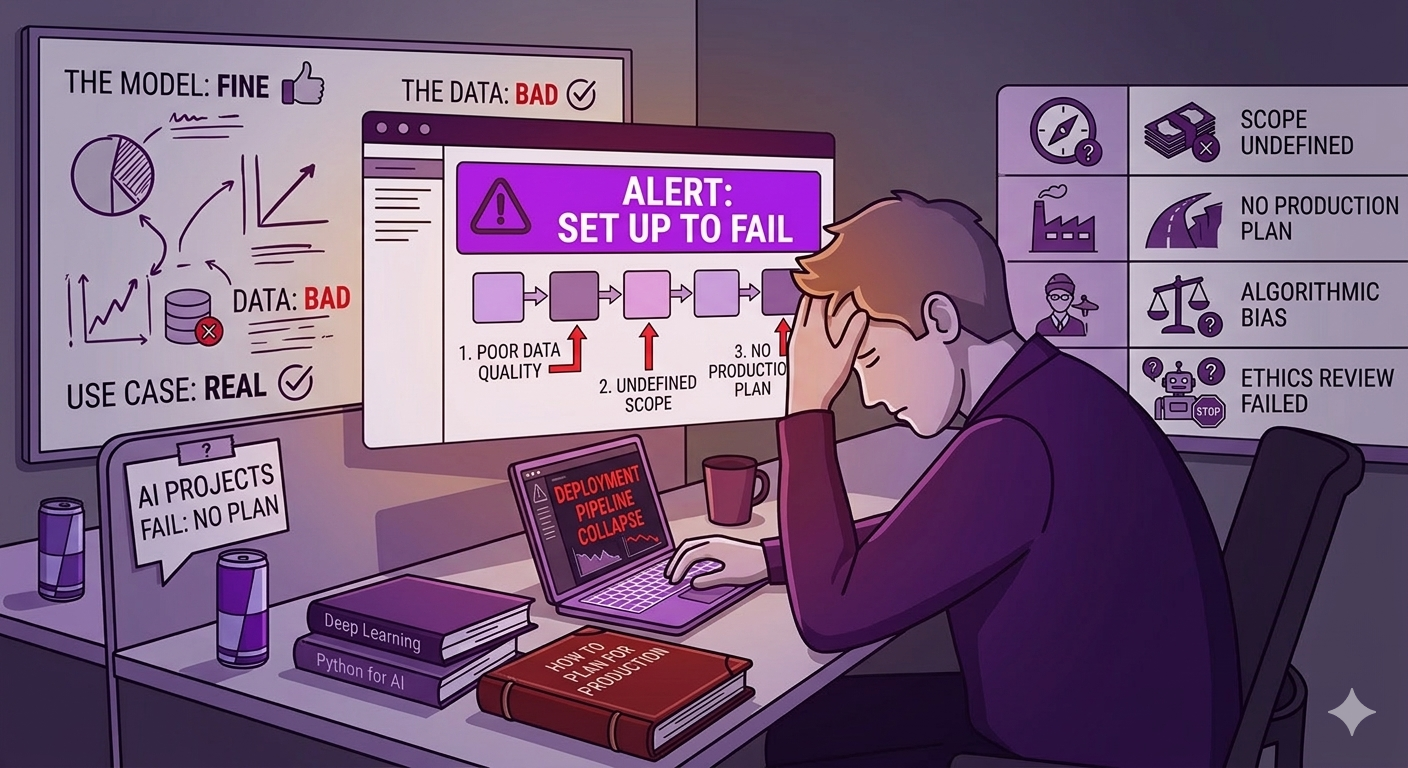
Most AI projects don’t fail because the technology doesn’t work. The model was fine. The data wasn’t. The use case was real. The scope wasn’t defined. The pilot worked. Nobody planned for production. The failure pattern is consistent enough that it stops being surprising — and repeatable enough that it’s preventable.
How bad are the AI project failure numbers?
The failure statistics for AI initiatives are striking, but headline figures can mislead. They tend to obscure what actually went wrong.
Gartner predicts that at least 30% of generative AI projects will be abandoned after proof of concept, citing poor data quality, inadequate risk controls, escalating costs, and unclear business value. That’s the abandonment rate after a working prototype exists. It doesn’t count projects that never made it that far.
BCG’s research across 1,000 C-level executives found that only 26% of companies generate tangible value from AI. The other 74% struggle to achieve meaningful scale. McKinsey’s 2024 State of AI survey found that while 78% of organizations now use AI in at least one business function, only 17% report that 5% or more of their EBIT comes from it.
The pattern across all of this research is the same: adoption is high, value realization is low. Organizations are running experiments. Very few are running production systems that change business outcomes. This is not a technology problem. It is a scoping, planning, and execution problem — and most of it is preventable.
Why does failing to define a business case sink AI projects?
The most common failure mode isn’t technical. It’s strategic. An AI initiative gets launched because a competitor announced something, or because an executive read a case study, or because the board asked why the company isn’t “doing AI.” The technology becomes the goal. The business outcome becomes secondary.
The anti-pattern looks like this: a team is tasked with “implementing AI” in a particular function. They pick a use case that seems tractable. They build something that technically works. Then nobody uses it, or the output isn’t trusted, or the process it was meant to improve turns out to require changes nobody planned for.
The fix is to start with the outcome, not the technology. What decision does this change? What process does it replace or accelerate? What does “working” actually look like, and how will you measure it? If those questions don’t have clear answers before scoping begins, the project is already at risk.
Framework
BCG’s research captures this with what they call the 10-20-70 principle: AI success is roughly 10% algorithms, 20% data and technology, and 70% people, process, and organizational change. Leaders who win fundamentally redesign workflows around the technology. Those who fail try to automate existing broken processes and wonder why the output is broken too.
How does data quality cause AI projects to fail?
Data quality is the single most cited cause of AI project failure across every major research body that has studied the question. It is also the most consistently underestimated risk at the start of a project.
Gartner’s 2024 survey of 1,203 data management leaders found that 63% of organizations either don’t have, or aren’t sure they have, the right data management practices for AI. Gartner predicts that through 2026, organizations will abandon 60% of AI projects that lack AI-ready data. That’s not a prediction about technology. It’s a prediction about preparation.
The specific failure pattern: a team builds a model using a clean, curated dataset assembled for the purpose of the pilot. The pilot works well. They move to production, where the data is live, messy, inconsistently labeled, and structured differently than it was in the test environment. The model degrades. The output loses trust. The project stalls.
AI-ready data is not the same as data that exists. It means data that is accurate, consistently structured, appropriately labeled, and governed in a way that can scale. Most enterprise data environments were not built with AI in mind. Closing that gap is real work, and it typically takes longer than the model development itself.
The fix is a data audit before scoping is complete, not after. If you can’t answer what data the model will be trained on, where it lives, who owns it, how current it is, and what happens when it changes, you are not ready to build.
Signal
What it means
Risk level
Data lives in one place, clearly owned
Governed, auditable, ready to use
Low
Data is spread across systems, inconsistently labeled
Significant cleanup required before model work begins
Medium
Nobody is sure where the relevant data lives
Data readiness is the first workstream, not a parallel track
High
What does scope creep look like in an AI project?
AI projects are particularly vulnerable to scope creep because the technology creates genuine curiosity. Once a working prototype exists, stakeholders start asking what else it could do. Each addition seems incremental. Together, they transform a focused tool into a platform nobody agreed to fund.
The moment things usually break is not planning — it’s the first demo. A working demo generates enthusiasm, and enthusiasm generates requests. “Could it also do X?” is a reasonable question. The problem is when the answer is always yes, or when nobody is tracking what yes costs.
The other version of this failure is ambiguity that was present from the start but never resolved. Requirements described as outcomes (“make our customer service faster”) without being translated into specific system behaviors. A scope document that reads more like a vision statement than a build plan.
The fix is forcing specificity before kick-off. What are the exact inputs? What are the exact outputs? What does the system do when the input is ambiguous or incomplete? What is explicitly out of scope? A scope that can’t answer these questions will generate change orders. It’s a question of when, not whether.
Not sure if your AI project is scoped correctly?
Fraction’s senior engineers scope AI initiatives every week. Get a full breakdown with story-point pricing and sprint estimates in minutes.
Deploying a large language model or a machine learning pipeline into a production environment is not the same as building a traditional software application. The failure modes are different. The testing requirements are different. The maintenance requirements are different.
A team experienced in web or enterprise application development can build the infrastructure around an AI system. What they often can’t do reliably is anticipate the specific ways AI systems degrade in production: model drift, hallucination in edge cases, latency under real load, behavior changes when input data shifts. These require engineers who have seen these failure modes before and know how to build the guardrails, monitoring, and evaluation systems that catch them.
The talent gap is real. Current research finds that 34 to 53% of organizations with mature AI implementations cite a lack of AI-native skills as their primary obstacle. Data scientists are expected to operate as full-stack engineers, mastering DevOps, model frameworks, and security practices simultaneously. That combination remains rare.
The practical implication: when evaluating a vendor or team for an AI build, the question is not whether they have built software before. It is whether they have deployed AI into production and maintained it past the first three months. Ask for specific examples. Ask what broke and how they caught it.
What happens when there is no plan for after the AI launch?
Deploying an AI system is not the end of the project. In some ways it is the beginning of a more demanding phase.
Models drift. The world the model was trained on changes, and the model doesn’t automatically update with it. A customer service model trained on 2023 data will start producing stale or wrong outputs as products, policies, and customer language evolve. Without a monitoring and retraining plan, that degradation happens silently.
User trust erodes. When an AI system produces a bad output — and it will — someone has to own the response. Was it the data? The prompt? The model? A change in inputs upstream? Organizations that haven’t built feedback loops and escalation paths into the system discover these questions only after confidence has already been damaged.
Integration dependencies accumulate. An AI system that connects to a CRM, a data warehouse, and an ERP becomes dependent on all of them. When any of those systems update, AI behavior can change in ways that aren’t immediately visible. Maintenance requires ongoing attention, not a post-launch handoff.
The fix is treating the post-deployment roadmap as a deliverable, not an afterthought. Before a project closes, you should have defined: who monitors model performance, what triggers a retraining cycle, how users report bad outputs, and what the escalation path looks like. If the vendor doesn’t raise these questions, raise them yourself.
What do the successful 26% of AI organizations do differently?
The organizations that consistently generate value from AI share a small set of behaviors. They are not the organizations with the biggest budgets or the most advanced technology.
They define the business outcome before selecting the technology. The question is not “what can we do with AI?” It is “what specific outcome are we trying to change, and is AI the right tool?”
They treat data readiness as a prerequisite, not a parallel workstream. The build doesn’t start until the data questions are answered.
They scope tightly and resist expansion. A focused tool that works reliably is worth more than an ambitious platform that partially works.
They staff with engineers who have shipped AI to production, not just built prototypes. And they plan for production from the beginning — monitoring, retraining, user feedback, and maintenance are part of the scope, not additions to it.
None of this is especially complicated. Most of it is discipline applied earlier than feels necessary at the time. The projects that fail are almost always detectable before the first line of code is written, if someone asks the right questions.
Frequently asked questions
Why do most AI projects fail?
Most AI projects fail not because of technology limitations but because of poor scoping, unready data, scope creep, and teams that haven’t shipped AI to production before. The failure pattern is consistent: a project gets launched without a clear business outcome, the data is messier than expected in production, requirements expand after commitment, and nobody has planned for maintenance and drift after launch.
What percentage of AI projects fail?
Research consistently shows high failure rates. Gartner predicts at least 30% of generative AI projects will be abandoned after proof of concept. BCG found that only 26% of companies generate tangible value from AI — meaning 74% struggle to achieve meaningful scale. McKinsey’s 2024 State of AI survey found that while 78% of organizations use AI in at least one function, only 17% report significant EBIT impact.
How does poor data quality cause AI projects to fail?
The common failure pattern is that a team builds a model using a clean, curated dataset assembled for the pilot. The pilot works. Then they move to production, where data is live, messy, inconsistently labeled, and structured differently than in the test environment. The model degrades, output loses trust, and the project stalls. Gartner found that 63% of organizations either don’t have, or aren’t sure they have, the right data management practices for AI.
What should an AI project scope document include?
A solid AI project scope should define the exact inputs and outputs, what the system does when inputs are ambiguous or incomplete, what is explicitly out of scope, how success is measured, what data the model depends on and who owns it, and what the post-deployment monitoring and maintenance plan looks like. A scope document that reads more like a vision statement than a build plan will generate change orders — it’s a question of when, not whether.
What is the difference between an AI prototype and a production AI system?
Deploying a large language model or machine learning pipeline into production is not the same as building a traditional software application. Production AI systems require monitoring for model drift, handling hallucinations in edge cases, managing latency under real load, and maintaining behavior as input data shifts. These failure modes are different from traditional software and require engineers who have seen them before and know how to build the guardrails that catch them.
What do the AI projects that succeed have in common?
Successful AI projects share a small set of behaviors: they define the business outcome before selecting technology, treat data readiness as a prerequisite rather than a parallel workstream, scope tightly and resist expansion, staff with engineers who have shipped AI to production, and plan for monitoring, retraining, and maintenance from the beginning. BCG describes this as the 10-20-70 principle — 10% algorithms, 20% technology, and 70% people, process, and organizational change.
Praveen Ghanta is a five-time founder and serial entrepreneur. He is the founder of DevHawk.ai, an AI-powered engineering management platform, and Fraction.work, which connects fast-growing companies with top fractional tech and growth marketing talent. Previously, he founded HiddenLevers, a risk analytics platform for wealth management that he bootstrapped from inception to acquisition by Orion Advisor Solutions in 2021, serving thousands of advisors and $600B in assets. He earlier founded SmartWorkGroups, acquired by Intralinks in 2000.
Describe your software or AI project. Get a full scope with story-point pricing, sprint estimates, and a downloadable plan in minutes. No calls, no waiting.